Showing posts with label Bela Tarr. Show all posts

2/11/12

Bela Tarr's TURIN HORSE


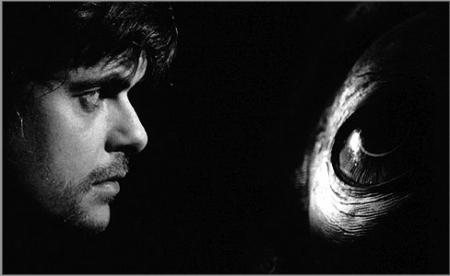
I just saw Tarr's latest (and probably last) movie at The Lincoln Film Center. The movie is much better than his "Man From London" and after "Satantango" it is his most daring work, and in many way it is the closest to the latter.
Out of all the movies he made, this one carries the simplest narrative (and one can argue maybe too simple): description of 6 days in the life of a poor farmer and his daughter. Stormy winds hit their old house and the stable where a horse is kept.
The film opens with a nice long tracking fluid shot where the camera sometimes comes too close to the horse from a low angle and at times it tracks the horse and the farmer from a distance. Day one starts, and the daily "rituals" are shown: getting water from the well, help the half-paralyzed man dress and undress, eating boiled potatoes...etc. Those acts are repeated daily, each day from a different camera perspective but with almost no variation in content. To describe the hard life they live, Tarr succeeds in creating horror from those mundane activities, there are few shots each morning when the father wakes up with a horrifying facial expression; it surpasses in effect any possible dialogue that the character can say. And add to this example many others that also work brilliantly: pealing the boiled potatoes and eating them every day with bare hands; even eating is torture for the characters. Very little words are spoken, but no dialogue is needed with Tarr strong images and actually almost all of what is said doesn't add to the narrative, including the voice-over narration (a la Satantango).
This movie has some of Tarr most haunting images: the mummified facial expression of the farmer that is shown every morning, eating potatoes (reminded me of Van Gogh's potato eaters), the final scene of the movie is a scene that lingers even after the light is out. None of those images are as strong as or as catalytic as the whale scene in W.Harmonies but the abundance/repetition of images in Turin Horse has a cumulative effect.
In Satantango Tarr manipulated time and memory by pushing the limit of cinema storytelling in a seven-hour-long movie, here he tried to achieve this "engraving" and "time condensing" effect with the persistence and repetition of his images. It works -to a lesser degree than Satantango- now I'm 6 hours after the screening and still left with clear visual memories of those six days the characters lived. It is very interesting how this movie does not need to any dialogue, one can watch this movie with no subtitles and still get the same experience.


Turin Horse is like Bergman's Passion and Shame, ominous things occur with no explanation but we know they're adding their weight on the character. In Turin Horse, we don't know why the horse stopped eating, why the well got dry...etc but we feel this ominous feel of entrapment and death. One very strong -and horrifying- image in Turin Horse is when the light went off, not only the gas light, but the actual day light in the middle of the day, that was done brilliantly with no visual or sound effects.

One of the negative things in the movie was the introduction, why did Tarr link this story to a time (1889), a place (Turin), and a historical figure (Nietzsche) ?? Actually one can argue that though this is mentioned in the first scene, there is nothing that states clearly that this the actual "turin horse"; what is said is "nobody knows" (see the first scene below). This relation to the Nietzsche incident can't be taken seriously unless Tarr is explaining why the latter went mad (him realizing the fate of the horse and its owners), this would be a long, and weak stretch. The other explanation is that being an absurd -and not that funny- joke. Had Tarr kept the time and place unrevealed (like in W. Harmonies) this would have added more depth to the narrative and the apocalyptic events (especially towards the end, when fire and light stop to exist) could have been attributed to the present or the future of mankind, as seen by Tarr.


Tarr uses his regulars, it's nice to see Estike, the troubled little girl from Satantango now as a grown up woman. Vig's simple 4-bar soundtrack also works beautifully as usual. Overall I wish I could say that this movie is as good as all the movie I mentioned (except the Man From London) but W. Harmonies, Bergman's Shame and Passion, and even Satantango had all more accomplished narratives.
However if this is really tarr's final work, it is far better than Bergman's Saraband and Tarkovsky's Sacrifice.

1/8/12

Ceylan's Once Upon a Time in Anatolia


Though Ceylan's latest work is described as a movie about police procedural and a detailed trip to recover a corpse, it is intended by Ceylan to be about the psychological/internal/existential journey that the involved professionals (mainly a prosecutor, a police officer, and a doctor) will take during this trip. There are other interesting characters, like the criminal himself and the driver but they are relatively less developed. The film promises a rewarding experience, but this is not the case. Despite the effort to give those characters depth and a believable existential struggle (the whole point of this movie), the result is half-acceptable for the most developed ones (the prosecutor and the doctor, to a lesser degree the driver), at times cartoonish (the officer)...etc
After the first half and especially towards the last third the movie starts to lose focus, some scenes are not needed, some scenes are forced to give some depth (the doctor going through old photos of his ex-wife to "explain" his reaction towards one woman they met on the trip). Though I think it will be criticized but I'm glad that Ceylan left the motive behind the murder almost unexplored, and so is the criminal's character. (At some point it is hinted that he is not actually the killer) This would have even a much stronger effect on the movie if the characters were written with more complexity to achieve the existential trip that Ceylan wanted.

That doesn't mean the movie is bad, but it is not an excellent work. Ceylan still suffers (despite the help from his wife and his friend) content-wise. This is a major problem. Some moments are great and well crafted and executed, those were mostly some mundane ironies that are scattered in the movie (similar to those in climates and distant). Visually the film is stunning (maybe his best).
Visually this movie is very similar to tarr's work (usually I don't compare Ceylan's to Tarr's work but I couldn't escape the resemblance with the Man From London and Damnation despite those being in Black and White). Theme-wise it has a lot of Kiarostamian moments: the landscapes of The Wind Will Carry Us, the falling objects: in "Close Up" an empty bottle, in The Wind Will Carry Us a fruit, here an apple keeps rolling aimlessly and is tracked by the camera. The professionals and even the trailer above itself may resemble Tarkovski's Stalker, though is movie is not even close to Tarkovski's excellent work.

So overall, it is a major step up from Three Monkeys substance-wise and style-wise (less contrasted and less digitally manipulated), but it is not near Distant or Climates. Maybe Ceylan will never be able to make a third great movie again, unless it's a skeleton cast of 2 or 3 unprofessional actors with less ambitious stories, or maybe he won't at all.

A much milder disappointment than Three Monkeys.

8/27/09

The Human Condition

Busy few days, so I'm finally watching Masaki Kobayashi's The Human Condition- a new Criterion Collection release, and a mamoth sized film at 9 1/2 hours.

That's over 2 hours longer than Bela Tarr's Satantango!

Here's the trailer:


So far, so good. I'm a third of the way thru, and, naturally, some trims should have been made, but, since it's the length of a de facto miniseries, I tend to compare it to some of the classics of that genre, like Upstairs, Downstairs, Rich Man, Poor Man, Roots, and The Thornbirds. And it's better....so far.

A bit preachy, and actually a bit too tame in its depiction of Imperial atrocities at work camps, since, by most accounts, even visiting Nazi officials- men who were running the European death camps, were startled at the brutality of the Japanese treatment of POWs. Of course, the first part of this film came out in 1959, so some restraint is to be expected, but overall, I'm hooked into the main character; a humanist who's at wits with his inner self.

More to come!

8/13/09

Bela Tarr And Silence

Hungarian director Bela Tarr is a bit of an enigma. Having seen most of his mature film work, he seems to have come to the place where his surname can be grafted on to a thing as an adjective.

I.e.- just as film mysteries with an odd twist have become known as Hitchcockian, sci fi tales with a twist ending Serlingesque (after the creator of the tv show The Twilight Zone), and inhuman dramas with long deliberate pauses Kubrickian, so too is it right to call deliberately paced films that focus on the internal human predicament Tarrian.

Here is the opening to Werckmeister Harmonies, and note the way the young man is anally trying to orchestrate the others:


Here is a later scene from the film, wherein a mob stops momentarily upon a memorable discovery:


And here is Satantango's opening:


In all instances, watch how Tarr focuses on a thing or two. His long takes dwarf even those of Theo Angelopoulos.

Here is an interview with the man:

Werckmeister Harmonies


The review is up.

7/7/09

There Will Be Blood

Just watched this latest Paul Thomas Anderson film and it's the latest in a series of so-called masterpieces from well known directors that are not what is claimed, and worse, represents a severe regression in the filmmaker's canon. Like N.B. Ceylan's Three Monkeys and Bela Tarr's The Man From London, this film is a regression for Anderson, and a worse film than Punch-Drunk Love, Boogie Nights, and even, arguably, Magnolia (yes, I know that had Tom 'The Mannekin' Cruise in it)

Simply put- no tale, hammy acting by Daniel Day Lewis, and no character development. It is Anderson's attempt to make a 21st Century Citizen Kane. But he's not Orson Welles.

The trailer:

6/24/09

Bela Tarr's 'Woody Allen' Moment

2007's The Man From London, by Bela Tarr, is the least of his 4 'mature' films I've seen, and for two major reasons.

1) the plot is not just confusing- as many critics claim of films they do not understand- just simplistic and not believable in its own diegetic timeline.

2) Tarr's film steals major visual and thematic elements from his earlier films- Satantango, Damnation, and Werckmeister Harmonies- and in far lesser ways, that it reminds me of Woody Allen's films of the last 17 years, as they mimic his 1977-92 Golden Age.

Along with the disappointment of N.B. Ceylan's last film, Three Monkeys, this pains me to say, but Tarr may be on a long downward slide from here. He just seems to have nothing left to say and no original ways to say it.

I just hope that when it's finally released on DVD, Theo Angelopoulos's The Dust Of Time does not also fail, like Tarr and Ceylan did.

Here's the trailer, and note it's nothing like the film, a clip of which follows below:


MAN FROM LONDON: Movie Trailer - The best home videos are here

5/8/09

Miklos Jancso's THE RED AND THE WHITE


This is my second Jancso, I'm still far from having a fair perspective on his work; but I can say one thing for sure: He loves large dynamic tableaux. The dynamism of his scenes is interesting, it's based mostly on numerous (up to hundreds) actors executing different asynchronous actions coming in and out of frame. He stages his actors often in groups at different distances from the camera, giving the shot depth (3-D perspective), adding the different actions in/out screen you'll have the feel of witnessing a giant complex machine in motion.

The first film I saw of his (Electra, my love) was a re-interpretation of the legend, in an neo-operatic theme. His control of the hundreds of actors during lengthy scenes is astonishing! I couldn't escape this thought: repeating a ten-minute shot of a hundred something actor if one mistake happens sounds really painful!

Back to The Red and The White, plotwise though it's a film about the 1920's war b/w the communists (Red) and the Czarist (White), it is a plotless movie, no main actors, no heroes. Jancso would lead us to follow a main "commander" everynow and then only to arrive to his demise very soon after, and that's a smart mechanism to describe the war: no intervention, no involvement, passive observation of different war figures, and the futility of the war itself.


Like many, I knew about Jancso after reading about Tarr, and I can see where this association comes from, yet Tarr is different from Jancso despite his adaptation of this "dynamism".
Not only Tarr's image is unrealistic, contrastest shadowy grey, black, and white. But also Tarr's "dynamism" is different (and more sophisticated):

1. Tarr doesn't constantly rely on large number of actors in his scenes like Jancso, to produce an effect of motion.
2. Tarr's camera's movement is more complex, often traverses through windows into different territoires. Jancso's camera follows, tracks, observes, rarely zooms, but doesn't cross planes.

Tarr even surpasses Tarkovski in manipulation, while the latter uses a slow paced rythm and a slow flow of images to create an effect (something he called Sculpting in Time, i.e using time to enhance the memory of an image, thus sculpting). Tarr uses time and his complex camera movement to distort our perception of time AND space. At times I am "lost" in a shot, in the very opening of Man from London, the full information about the "place" is giving SLOWLY through the flow, the close follow up over stuctures, furniture... adding the "actual" action (not created by the camera movement) the camera captures. Anotonioni and Teshigahara did that at some elementary level, They would start a scene by a confusing close up, but nobody like Tarr pushed that effect to such level.

Jancso is different from Tarr and anybody else, and "The Red and The White" is worth watching for its splendid tableaux, including a hauting scene (at the end) of an army gathered on a triangular-shaped open land surrounded by water.

WASSIM

4/20/09

Three Monkeys Redux

Ok, I got the DVD of Nuri Bilge Ceylan's latest and will watch it this week.

He, like Bela Tarr, seems to get better with each film, so here's to trends.

And here's the trailer:

4/14/09

Miklos Jancso

Have heard that he is a big influence on Bela Tarr, and this is one of three DVDs of his I recently got. I must say, in the few scenes you can find online, I don't see much of a connecting thread.

Here is a clip from his most famous film:


We'll see.

4/2/09

Werckmeister Harmonies

Saw another Bela Tarr film today, Werckmeister Harmonies. Simply a great film.

Tarr uses only a few dozen shots in this near 2 1/2 hour long film, and, unlike other of his films, no one can accuse this film of lacking emotion. Here are the opening scenes and a great scene central to the film.


Tarr pushes the envelope even farther than Antonioni and Angelopoulos. This is not to say that he's better, simply extending the art. Can't wait till The Man From London hits DVD, and also look forward to his earlier works.

2/12/09

Satantango

Yesterday I finished watching Bela Tarr's 7 hour film Satantango (it took 2 days), and it's a great achievement. I will write a long essay on it over the next few days, but it really changes the perspective one has on time. Like the poetry of Walt Whitman, there are some demonstrably bad features to it, and some self-indulgence; but, like the Good Gray Poet, if one shortened the scenes, one would lose pacing, character development (yes, even in the excess there is a purpose- see the scenes with the obese drunken Doctor or psychotic little girl), and some other positives. Thus, while a shorter version would gain some, it would also lose some, but it would, essentially be a different film.

Here is a video of the great opening sequence. The music choices in this film are marvelous, and, despite this being a realistic drama, one can see the influence of horror films, from the silents through the Universal films of the 30s through the Hammer films of the 60s and 70s in this one sequence.


That all said, the one thing this film is NOT, is an epic, for it is a highly intimate and cozy little seven hour marathon.

1/17/09

Damnation

Here is a review of the above named Bela Tarr film.

He's someone I want to watch more of because, while this film is not perfect, it is far beyond most Hollywood tripe.

Here is a video clip: