Ebert misses the mark on this one--praising Saving Private Ryan yawnfest over this. Funny he'll crit the "cliches" in Full Metal Jacket but not see them in this one. But I still luv ya Roger.
Showing posts with label The Thin Red Line. Show all posts
Showing posts with label The Thin Red Line. Show all posts
10/9/09
The Thin Red Line
James Jones also wrote The Thin Red Line. One of these days I have to watch the 1964 film version, with Keir Dullea of 2001: A Space Odyssey fame.
Until then, I'll have to rewatch Terrence Malick's film:
Until then, I'll have to rewatch Terrence Malick's film:

8/10/09
Days Of Heaven
Terrence Malick has released only four completed films in his four decade career, yet all are superb. Two are utter masterpieces: 1998's The Thin Red Line, which was unfortunately overshadowed by Steven Spielberg's horrid Saving Private Ryan.
That film was every bit as grim as Spielberg's film, including bloody reality, but it had a transcendent core that the cliche-ridden Spielberg film lacked.
On the other hand, some would argue that a film Malick made twenty years earlier, Days Of Heaven, was even greater. I would not, but the arguments can rage over which of the two is better. What is inarguable is that both are great. Indeed, both are masterpieces of American and world cinema.
My review of the earlier film is finally up at Cinescene, and I take my usual shots at some of the poor criticism that swamped this film, even by those critics who 'liked' the film. Of course, like has nada to do with excellence, and is especially galling when a film like this is so manifestly great.
Simply put, most critics just whiff when they try to take on a film, or any work of art that is so great, and in my reviews (which are technically essays, not merely reviews- but hail the power of the key word in search engines) I not only critique the artwork, but the critics who consistently muff their jobs, for only in doing so can they, and the art loving populace, truly get the most out of art that is great and not so great.
Herein a clip from the titular film:
That film was every bit as grim as Spielberg's film, including bloody reality, but it had a transcendent core that the cliche-ridden Spielberg film lacked.
On the other hand, some would argue that a film Malick made twenty years earlier, Days Of Heaven, was even greater. I would not, but the arguments can rage over which of the two is better. What is inarguable is that both are great. Indeed, both are masterpieces of American and world cinema.
My review of the earlier film is finally up at Cinescene, and I take my usual shots at some of the poor criticism that swamped this film, even by those critics who 'liked' the film. Of course, like has nada to do with excellence, and is especially galling when a film like this is so manifestly great.
Simply put, most critics just whiff when they try to take on a film, or any work of art that is so great, and in my reviews (which are technically essays, not merely reviews- but hail the power of the key word in search engines) I not only critique the artwork, but the critics who consistently muff their jobs, for only in doing so can they, and the art loving populace, truly get the most out of art that is great and not so great.
Herein a clip from the titular film:
7/21/09
Another Woman.
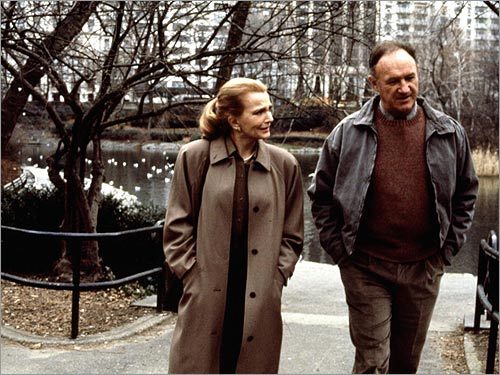 Imagine taking the best from a Bergman film and making it better. This is just what Woody Allen does in his masterpiece Another Woman, starring Gena Rowlands as Marion Post. Allen of course has never been shy when it came to his admiration for the great Swedish director, though this could not be more apparent than in the opening sequence of the film, which much resembles Bergman's 1955 classic, Wild Strawberries.
Another Woman tells the story of a philosophy professor named Marion Post who has basically lived a "cold and cerebral life," and has not allowed herself to feel passion. She is married to a cold doctor (Ian Holm) who cheated on his previous wife with Marion. Likewise, it is the second marriage for Marion also, for earlier in the film we see that she married a much older man (her professor), who seemed to love her, although she refused to have a child with him.
 Another Woman dips into past and present, memory and forgetting, and it is quite possibly one of the greatest films about human loneliness ever made (with its only rival being Terrence Malick's masterpiece The Thin Red Line). The film begins with Marion taking a leave of absence from work so she can write a book, so she subleases a flat downtown, which happens to be next door to a therapist's office. Marion is able to clearly hear the patients, and it is through hearing their stories, that she begins to make connections within her own life.
Mia Farrow plays the pregnant Hope, who much resembles the Klimt painting with the same title. She is a regular patient to the therapist next door, and Marion takes an interest in her after overhearing Hope's therapy sessions.

Marion loses touch with her close friend Claire (Sandy Dennis) who later admits she withdrew from their friendship because of Marion's competitiveness with a man Claire admired. Likewise, Marion has distanced herself from her brother, though she does not realize this, as it is her brother who has distanced himself from her. As the film progresses, Marion begins to evaluate her life and she learns just how she's been judgmental and has stood above and evaluated others, thus causing them to want to pull away. And all this realization comes with Marion's turning 50.
The one man she feels true feelings for is Ken's friend Larry Lewis (Gene Hackman) but she pulls away from the warm and passionate Larry so she can instead marry the cold and cerebral Ken. Later on in the film, Larry makes himself present in one of her dreams, where she confesses to thinking about him "more than once in a while." He, in turn, tells her to do so only without regret. This scene ties in when Marion later meets Hope in a restaurant and Marion is speaking about her own regrets, including the abortion she had years ago, while she was still married to her first husband.

The cinematography is beautiful, as it is performed by the same cinematographer Bergman used, Sven Nyquist. The tones and colors all correspond with the mood of the film, and there is one particular scene where Marion is reading over the famous poem "Archaic Torso of Apollo" by the German poet Rainer Maria Rilke, which quotes the line, "You must change your life."
The film works in accordance to the poem, as Marion comes to not only recognize her personal loneliness, but also wishes to change it. Gena Rowlands gives an astounding performance as the cold, cerebral Marion, while also exuding a warmth at the same time (possibly that hidden passion she's not allowed to escape all these years).
 The film ends beautifully, while she is reading an excerpt that Larry Lewis has written about her in his new novel, and the scene is recreated, where Larry notes that he recognizes her passion, and that her passion is something that can in fact be, if only she allows it. Thus she asks the question if a memory is something you have or something you've lost.
Another Woman is one of the best films ever made. There are so many angles to explore in this film, that one just has to see it. There might be more Marion in you than you think.
7/4/09
The Thin Red Line
After watching some docs on the Pacific War I got to thinkin' I gotta rewatch The Thin Red Line, by Malick. It's one of those films you just know is great 5 or 10 minutes into it.
It's odd, because more people died in the Pacific Theater than the European one, the Japs killed more Chinese than the Nazis did Soviets, they did experiments even more barbaric than Mengele's, Japan outlasted Germany in the war, and would not even have surrendered after the second atomic bomb, while Hitler went and killed himself. One of these days, someone (NOT KEN BURNS!) will have to do the definitive tale of the Pacific War, becasue it's one of the great underreported events in world history.
The trailer:
It's odd, because more people died in the Pacific Theater than the European one, the Japs killed more Chinese than the Nazis did Soviets, they did experiments even more barbaric than Mengele's, Japan outlasted Germany in the war, and would not even have surrendered after the second atomic bomb, while Hitler went and killed himself. One of these days, someone (NOT KEN BURNS!) will have to do the definitive tale of the Pacific War, becasue it's one of the great underreported events in world history.
The trailer:
6/6/09
The Thin Red Line
I've not seen the 1960s film version of James Jones' novel, which is supposed to be more in sync with the novel, and starring Keir Dullea (2001: A Space Odyssey), but Terrence Malick's The Thin Red Line (1998) is his greatest film.
I recall seeing it in the theaters, and immediately knew this was a great film, way beyond Steven Spielberg's schlockfest on D-Day and after, Saving Private Ryan.
A clip:
I recall seeing it in the theaters, and immediately knew this was a great film, way beyond Steven Spielberg's schlockfest on D-Day and after, Saving Private Ryan.
A clip:
Subscribe to:
Posts (Atom)